
AI · Model releases
Claude Fable 5.1: what changed, what breaks, and what it costs
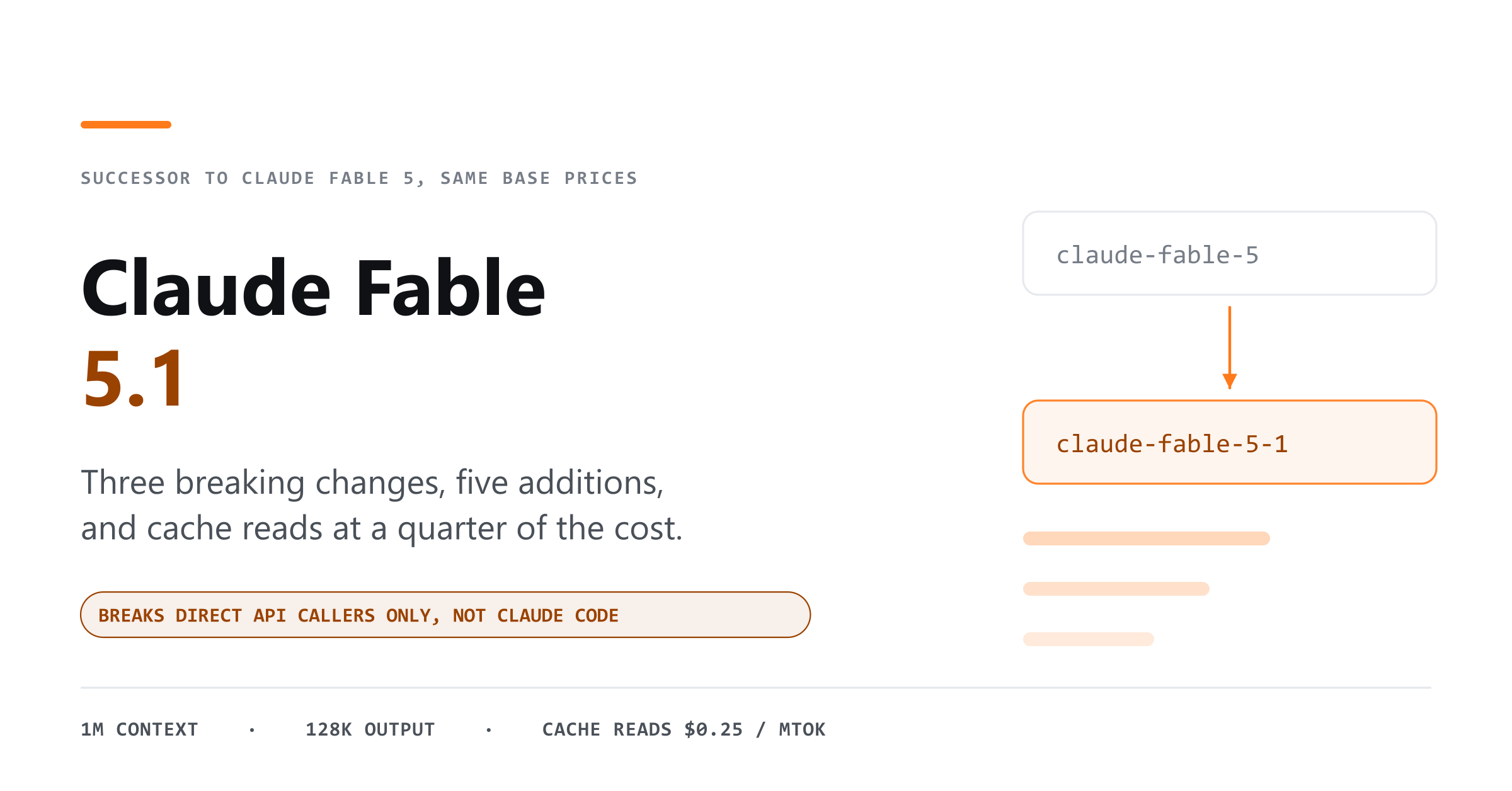
Anthropic has shipped Claude Fable 5.1, and the headline is refreshingly boring: same input and output prices as Fable 5, cache reads at a quarter of the cost, and a short list of real breaking changes instead of a vague "improved everything". If you build anything on the Claude API, the whole release fits in one read.
Everything below comes from Anthropic's own what's new page, the same rule this blog applied to the GoHighLevel Events beta: read the vendor's document, not the paraphrase ring around it. Nothing here is a third-party claim.
What Claude Fable 5.1 actually is
The successor to Fable 5, at API ID claude-fable-5-1. The spec sheet is unchanged where it matters: a 1M token context window at standard per-token pricing across the whole window, 128k max output tokens, adaptive thinking always on with the effort parameter controlling depth, and the same tokenizer. The gains are concentrated in long agentic coding sessions, document and spreadsheet work, multistep research, vision on dense charts, and computer use.
Two positioning facts worth repeating straight from the vendor. First, Anthropic itself says most workloads should start with Claude Opus 5, and reach for Fable when demanding reasoning or long-horizon agent work makes Opus fall short on your own evals. Second, Claude Mythos 5.1 is the same model with fewer safety measures, and it is offered only to approved organizations in Project Glasswing, so for almost everyone reading this, Fable is the tier that exists.
Three breaking changes, and who they actually hit
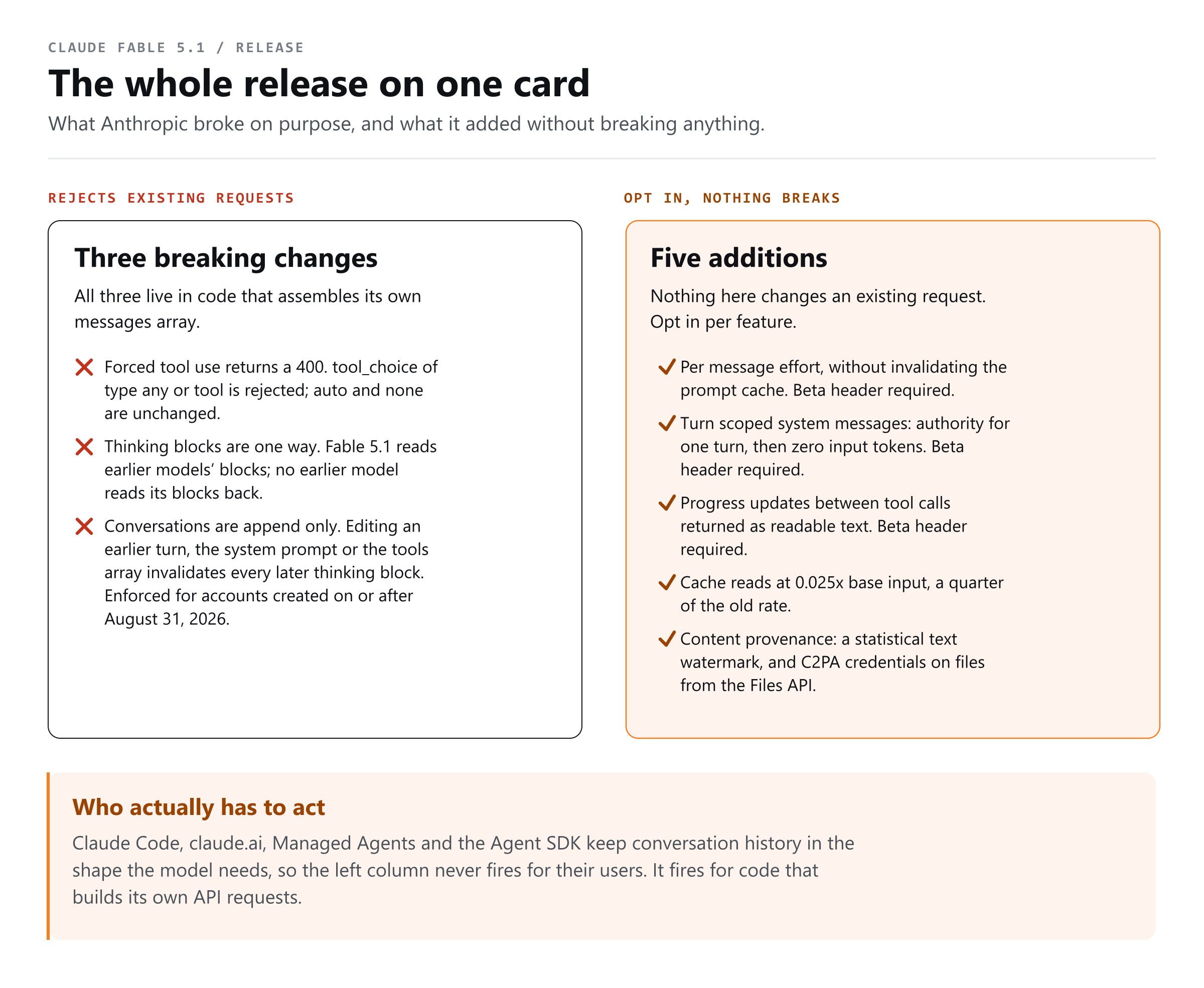
All three live in the same place: code that assembles its own messages array. If that is you, this section is the whole release.
- Forced tool use is gone.
tool_choiceof typeanyortoolnow returns a 400 error. Thinking is always on, and a forced call would skip it, so the model would write its reasoning into the tool arguments. The replacements: keeptool_choiceonautowith strict tool use for schema-valid JSON, move the schema to structured outputs, or simply tell the model in the prompt when the tool applies. - Thinking blocks are one-way. Fable 5.1 reads earlier models' thinking blocks, but no earlier model reads Fable 5.1's. A router or fallback that switches models mid-conversation silently loses reasoning on the downgrade path unless you opt into the beta header that reports the drop. Dropped blocks are not billed.
- Conversations are append-only. Editing anything before a thinking block, the system prompt, the tools array, or an earlier message, invalidates every block after it and earns a 400. Enforced for accounts created on or after August 31, 2026; older accounts opt in via
prefix_mismatch_behavior. Per-turn reminders you inject and delete are exactly the pattern that trips this, and turn-scoped system messages are the sanctioned replacement.
Five additions, aimed at agent builders
- Per-message effort (beta). Change the effort level mid-conversation without invalidating the prompt cache. Raise it for the hard step, drop it for the routine ones.
- Turn-scoped system messages (beta). A system message with
clear_at: "next_user_message"carries authority for one turn, then stops rendering and costs no input tokens, while the history stays untouched. - Progress updates as text (beta). The model writes short status lines between tool calls, and
display: "updates"returns them as readable text while reasoning stays hidden, so a long agent turn no longer looks silent to your users. - Cache reads at 0.025x base input. A quarter of the old rate. Covered properly in the pricing section below.
- Content provenance. Text output carries a statistical watermark on every platform, and supported image and video files retrieved through the Files API carry signed C2PA Content Credentials. The watermark adds no tokens and no hidden characters.
What changes with no code change at all
These arrive the moment you swap the model ID, and each one has a documented prompting fix. The model batches parallel tool calls less consistently, so long agent loops may spend extra turns doing reads one at a time. It narrates less during long tool runs. At low effort it answers from memory more often instead of reaching for a search tool. Its prose runs denser in places, it uses less formatting in chat, it is more willing to quote a source without quotation marks, and it leans toward rewriting a whole file where a targeted edit would do. None of these reduce answer quality, but the tool-batching and whole-file habits cost real tokens and wall-clock time in agent loops, which is worth knowing before your bill explains it to you.
Pricing: the cache read cut is the story
| Base input | 5m cache writes | 1h cache writes | Cache reads | Output |
|---|---|---|---|---|
| $10 | $12.50 | $20 | $0.25 | $50 |
Every number except one is identical to Claude Fable 5. Cache reads cost 0.025 times base input on this model against 0.1 times on other Claude models, so a long agent session that keeps re-reading a cached prefix, which is what every coding agent does all day, pays a quarter of what it used to. Batch processing is $5 per million input tokens and $25 per million output. The model is on the Claude API, Amazon Bedrock, Google Cloud and Microsoft Foundry.
How to migrate without surprises
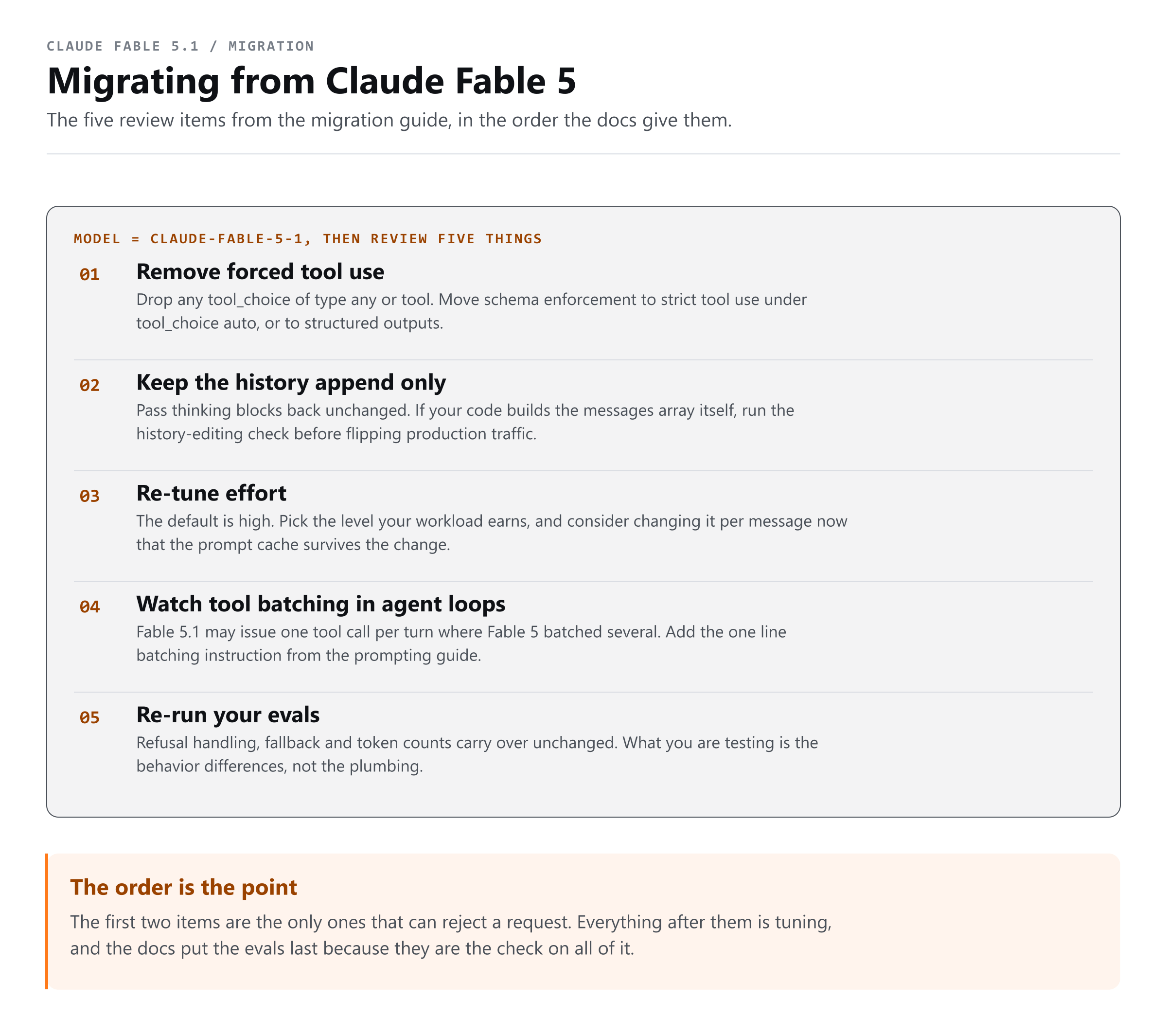
- Swap the model ID to
claude-fable-5-1, then remove anytool_choiceof typeanyortooland move schema enforcement to strict tool use or structured outputs. - Keep the history append-only and pass thinking blocks back unchanged. If your code builds the
messagesarray itself, run the history-editing check in the migration guide before flipping production traffic. - Re-tune effort instead of inheriting the default of high, and consider changing it per message now that the cache survives the change.
- In agent loops, watch for one tool call per turn where the old model batched several, and add the one-line batching instruction from the prompting guide.
- Re-run your evals. Refusal handling, fallback and token counts carry over unchanged, so what you are testing is the behavior differences, not the plumbing.
Is Claude Fable 5.1 more expensive than Fable 5?
No. Base input, cache writes and output are priced identically. The one change is in your favor: cache reads dropped to $0.25 per million tokens, a quarter of the previous rate.
Do I need to change anything in Claude Code?
No. The breaking changes concern code that assembles its own API requests, and Claude Code keeps conversation history in the required append-only shape for you. You may notice behavior differences, fewer batched tool calls and less narration during long runs, which are prompt-addressable.
What is Claude Mythos 5.1 and can I use it?
The same underlying model without the additional safety measures on dual-use capabilities, offered only to approved organizations in Project Glasswing. Unless your company has been through that approval, Fable is the version available to you.
Can I still force the model to call a specific tool?
Not with tool_choice. Forcing a call would skip thinking, so the API now rejects it with a 400. Anthropic's documented position is that explicit prompt instructions are followed reliably, and strict tool use or structured outputs cover the schema-enforcement half of the old pattern.
The short version
Claude Fable 5.1 is the rare model release where the honest summary is short: nothing gets more expensive, agent-heavy workloads get meaningfully cheaper through cache reads, and the three things that break are all in one place, hand-built conversation history. If you call the API directly, run the migration checklist. If you live in Claude Code, swap nothing and enjoy the price cut you were not asked to earn.
I build automations and client tools on Claude daily and write up what actually changes rather than what a press release says changed. The free guides cover the working-with-AI side, and the about page says who is writing this and by what rules.
More from the blog
- GoHighLevel Events: what the beta can and cannot do yet
HighLevel's new Events product area: what the beta does, what it cannot do yet, and what is still undocumented.