
Prompt Engineering
Writing the instruction so the answer comes back right
Prompt engineering is just writing your request well. It is the cheapest skill here and the one that changes your results the most. No coding involved.
What it really is
Prompt engineering sounds technical. It is not. It means writing your request clearly enough that the AI can only give you one kind of answer: the one you wanted.
Most people blame the AI when the answer is generic. Nearly always, the request was generic first.
Why the AI cannot ask you
A human freelancer would message you back and ask. The AI usually will not. It answers with what it has. So a missing detail does not come back as a question. It comes back as a guess that looks confident.
The four parts
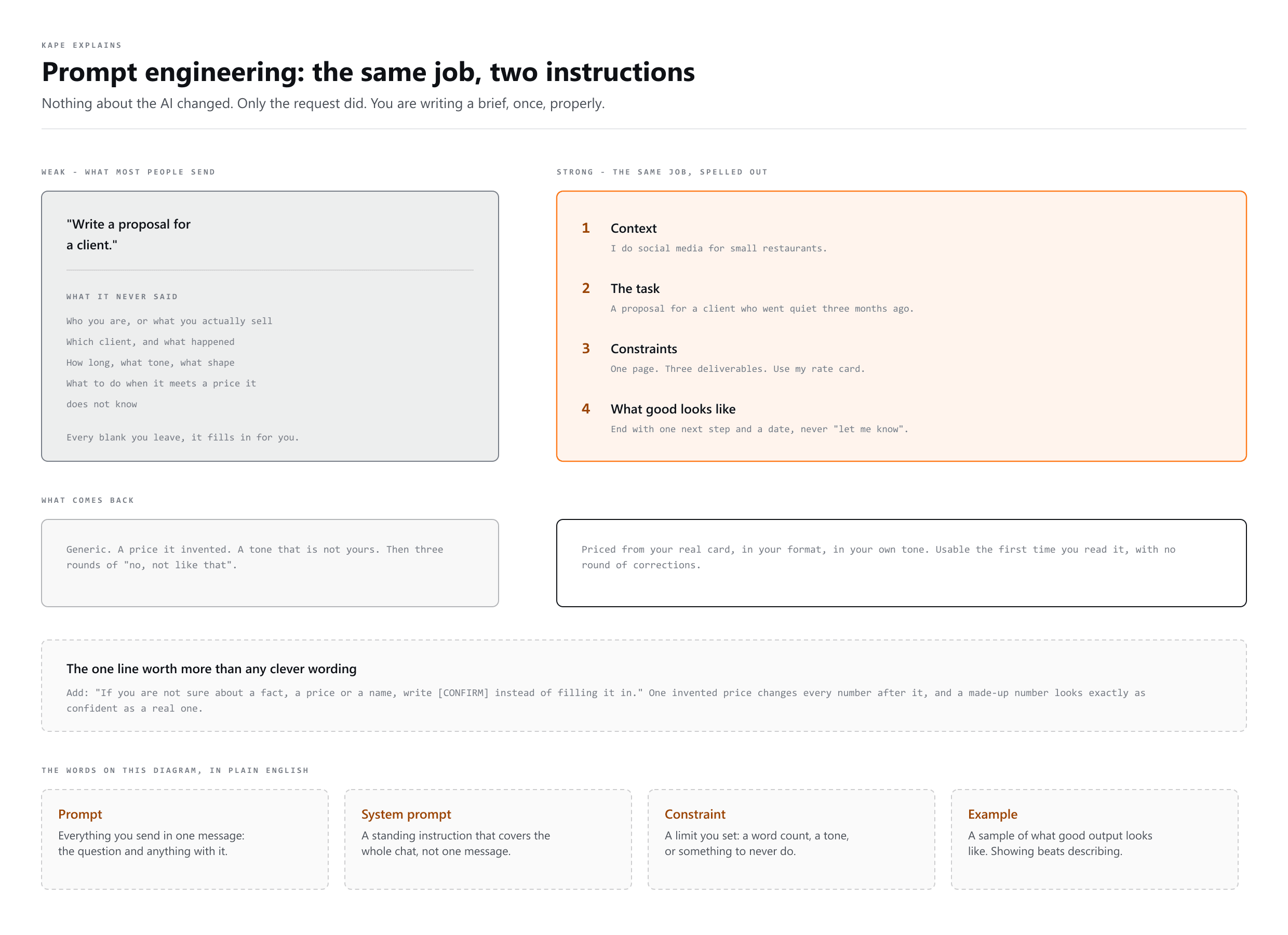
- Context. Who you are and what this is for. "I run a small VA agency in Cebu."
- The task. One clear thing to make. "Write a follow-up email to a client who has gone quiet."
- Constraints. Length, tone, format, and what to never do. "Under 120 words. Warm but not desperate. Do not offer a discount."
- What good looks like. An example, or a standard to match. "Match the tone of the message I pasted below."
You will not always need all four. You will notice fast when you skipped the one that mattered.
See the difference
Weak:
  Write a proposal for a client.

Strong:
  I do social media management for small restaurants.
  Write a proposal for a client who asked for help after
  their posting went quiet for 3 months.

  One page. Three deliverables, no more.
  Use the prices in the rate card I pasted below.
  If a price is not in there, write [CONFIRM] instead of guessing.
  End with one next step and a date, never "let me know".
The strong version takes about thirty seconds longer to type. It saves three rounds of "no, not like that".
Habits that work straight away
- Paste the real thing. The real email thread, the real notes, the real error message. Do not summarise it first. Summarising is the AI's job.
- Say who it is for. "Explain this to a client with no technical background" gives a very different answer from "explain this to a developer".
- Ask for the shape. A table, five bullets, one paragraph, a checklist. Otherwise you get prose you then have to reshape yourself.
- Show, do not describe. One sample of your own writing beats three adjectives about your tone.
- Correct, do not restart. "Too formal, and cut the second paragraph" is faster than rewriting the whole prompt.
- Ask it what it needs. "What do you need to know before you draft this?" finds the gaps you did not think of.
The one line that saves you most
Ask for thinking, not just an answer
When there is a decision involved, ask for options and the trade-off of each. "Give me three options and what each one costs me" gives you something you can judge. "What is the best option" gives you one confident answer with no way to check it.
Mistakes that quietly waste your time
| Mistake | What happens | Do this instead |
|---|---|---|
| Being polite instead of clear | Padding, no extra quality | Be direct. It does not get offended. |
| Five questions in one message | Five shallow answers | One task per message |
| One chat running all week | Answers get vaguer | New chat per task |
| Trusting a number because the writing was good | A wrong figure in a client document | Check anything you would be embarrassed to get wrong |
When a better prompt is not the answer
Prompt engineering has a ceiling. Better wording cannot give the AI a fact it was never shown, cannot empty a conversation that is already full, and cannot hand it an ability it does not have.
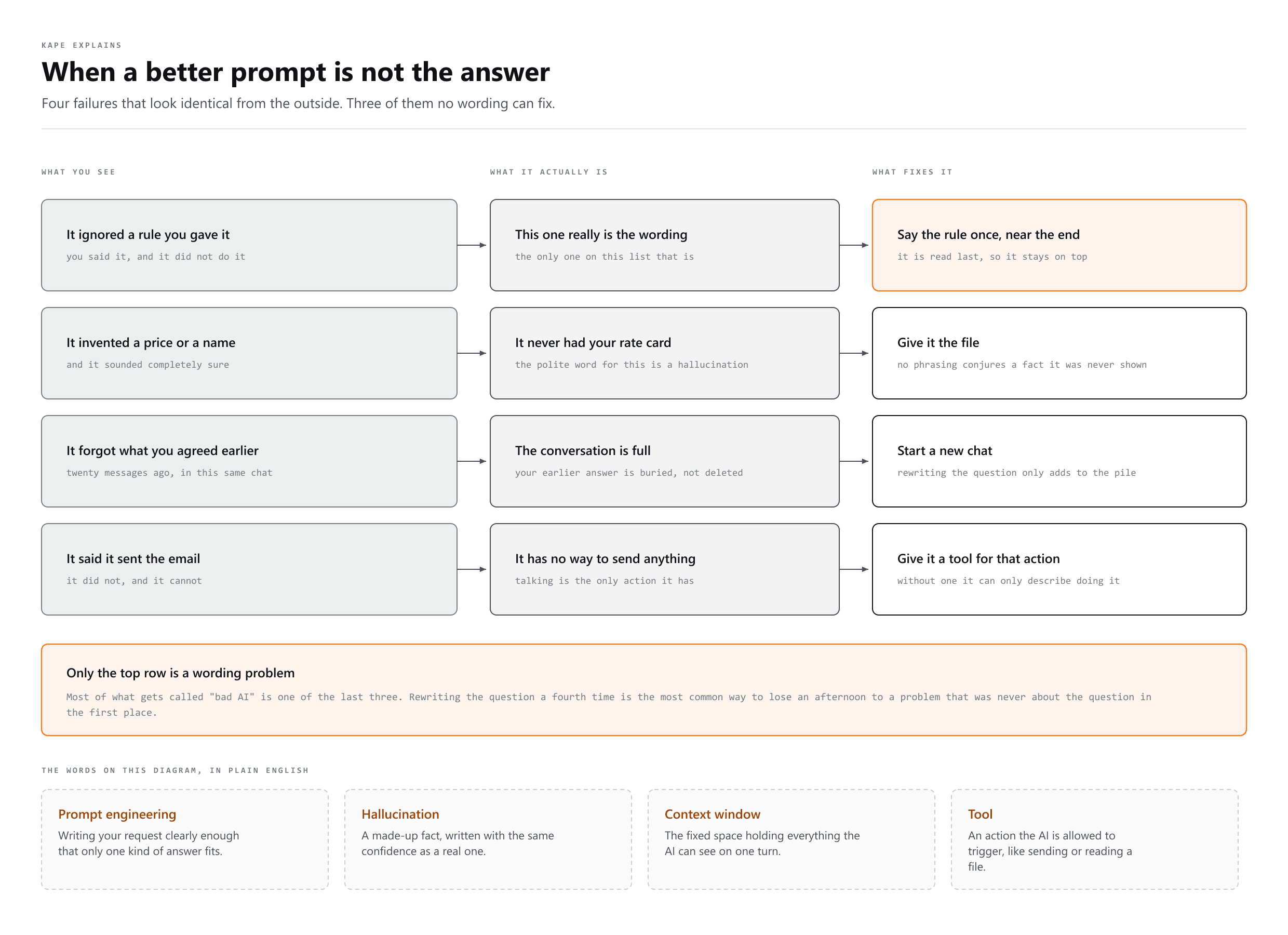
- It ignored a rule you gave it. This one really is yours. Say the rule once, plainly, and put it near the end, where it is read last.
- It invented a price, a name or a date. It never had your rate card. No phrasing conjures a fact it was never shown. Give it the file.
- It forgot something you agreed twenty messages ago. The conversation is full. Rewriting the question adds to the pile. Start a new chat.
- It said it sent the email. It has no way to send anything. Without a tool for that exact action it can only describe what it would do.
Most of what gets called "bad AI" is one of the last three. Rewriting the question a fourth time is the most common way to lose an afternoon to a problem that was never about the question.
Where prompts should live
If you type the same instructions every day, stop typing them. Put them somewhere they load by themselves: a saved style, a project instruction, a skill file, or a CLAUDE.md. A prompt you rewrite daily is a prompt you have not finished writing.
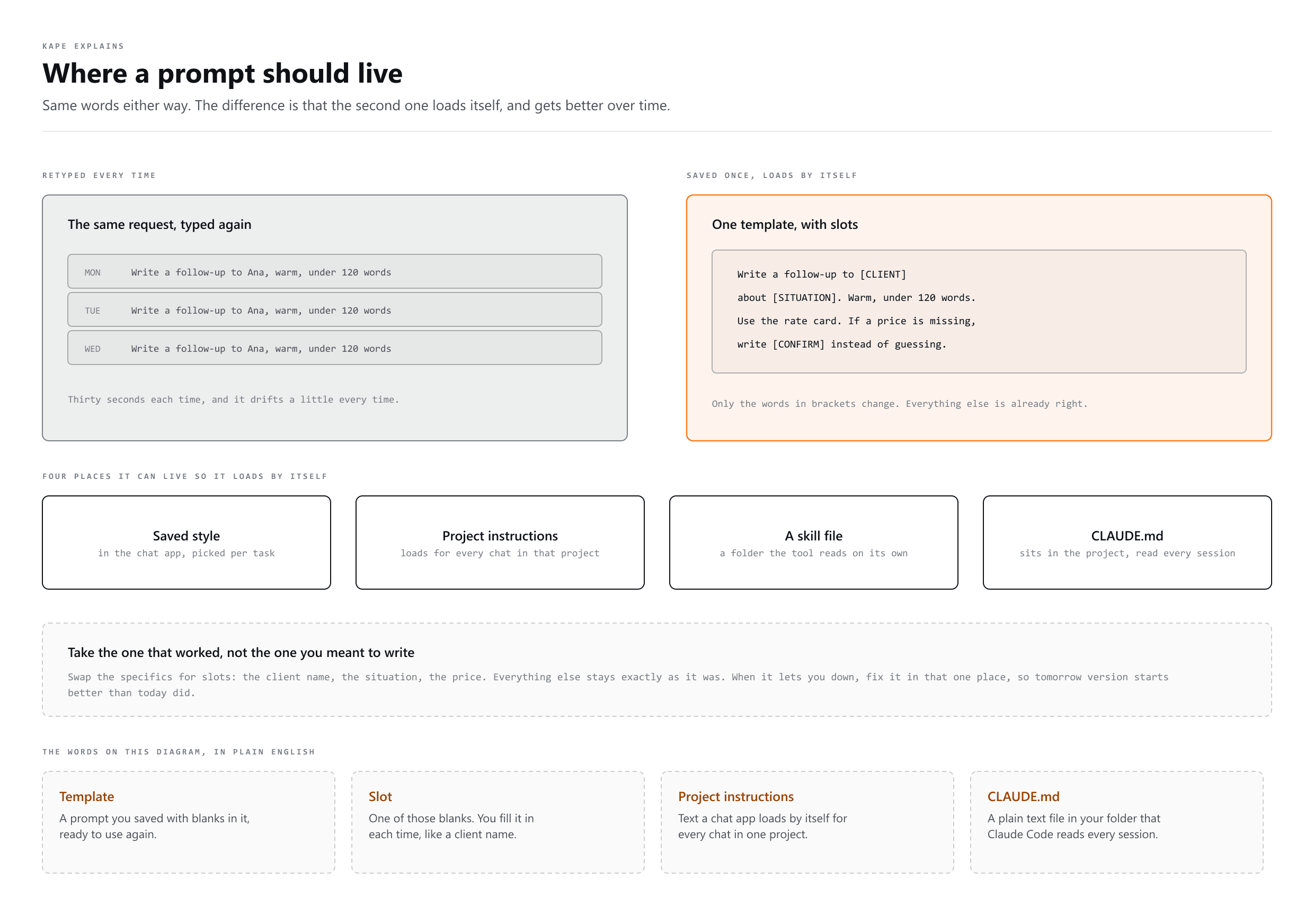
- Take the one that worked. Not the one you meant to write, the one whose answer you actually used.
- Swap the specifics for slots. Client name, situation, price. Everything else stays exactly as it was.
- Save it where it loads by itself. A saved style, project instructions, a skill file, or a
CLAUDE.md. - Fix it in that one place when it lets you down, so tomorrow's version is better than today's.
More words
- Context Engineering
Choosing what the AI gets to see while it answers
- Loop Engineering
Teaching an AI to check on its own, no prompt needed
- Graph Engineering
How many AI agents connect and work as a team.