
RAG: Giving the AI Your Own Facts
Look it up first, then answer
RAG means the AI searches your documents before it answers. It is how you stop it guessing about your business, your prices and your clients.
The problem
The AI knows a lot about the world. It knows nothing about your world. It has never seen your rate card, your client list, your service agreement or last month's numbers.
Ask it anyway and it will still answer, because it always answers. That answer is a guess wearing a confident voice.
What RAG actually does
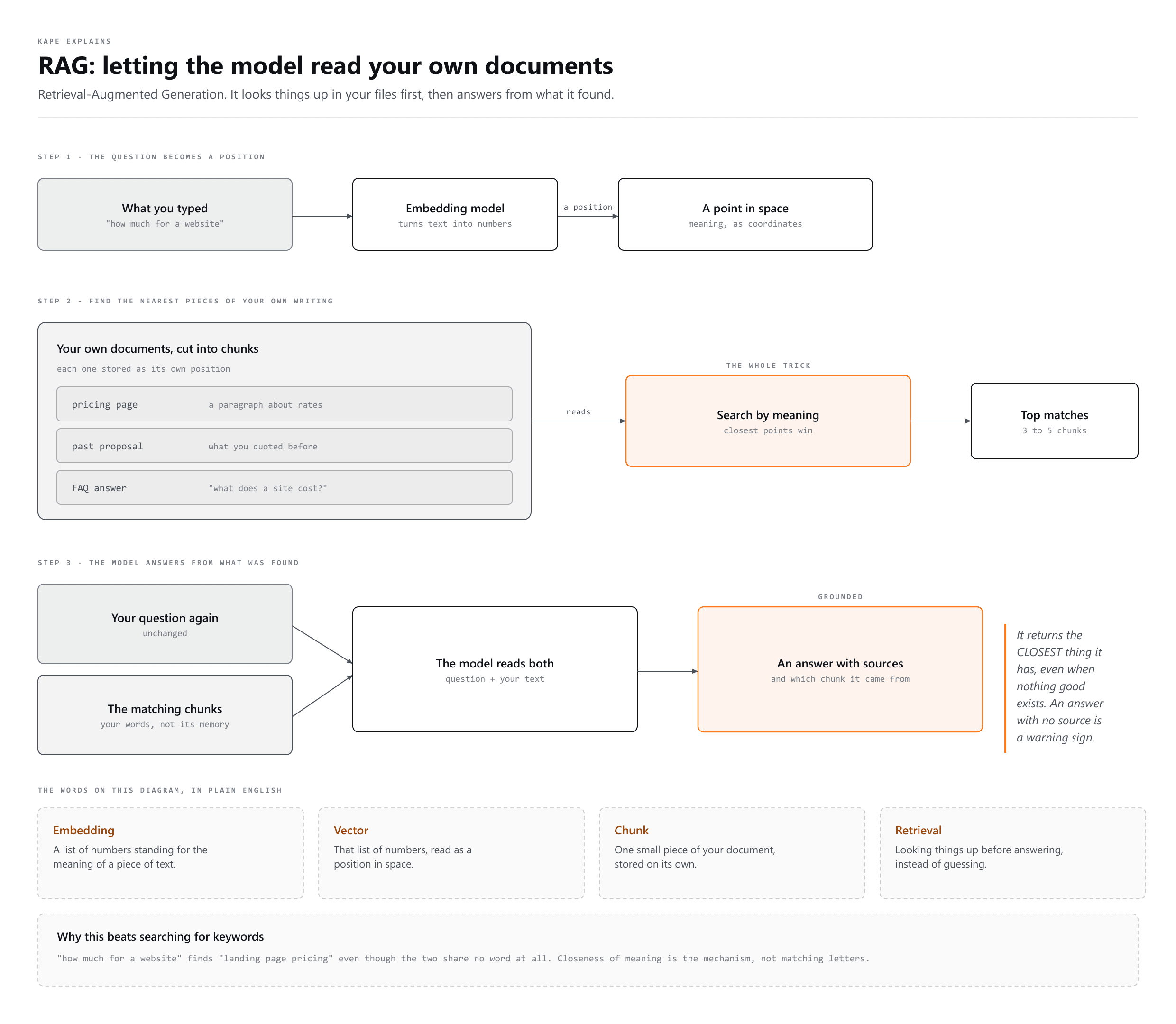
- You ask a question.
- The system searches your documents for the parts that look related.
- It takes the best few pieces, maybe three or five.
- It puts those pieces plus your question in front of the AI.
- The AI answers using them, and can point at which file it used.
That is the whole idea. The clever part is step 2: the search finds text by meaning, so a question about "how much for a website" can still find a document that says "landing page pricing".
But how can a search understand meaning?
This is the part that sounds like magic, and it is not. It comes down to one idea: turn text into numbers, in a way where similar meanings end up with similar numbers.
A small program called an embedding model reads a piece of text and writes out a long list of numbers. Not a summary, not keywords. Just numbers. The same text always gives the same numbers, and text that means something similar gives numbers that are close.
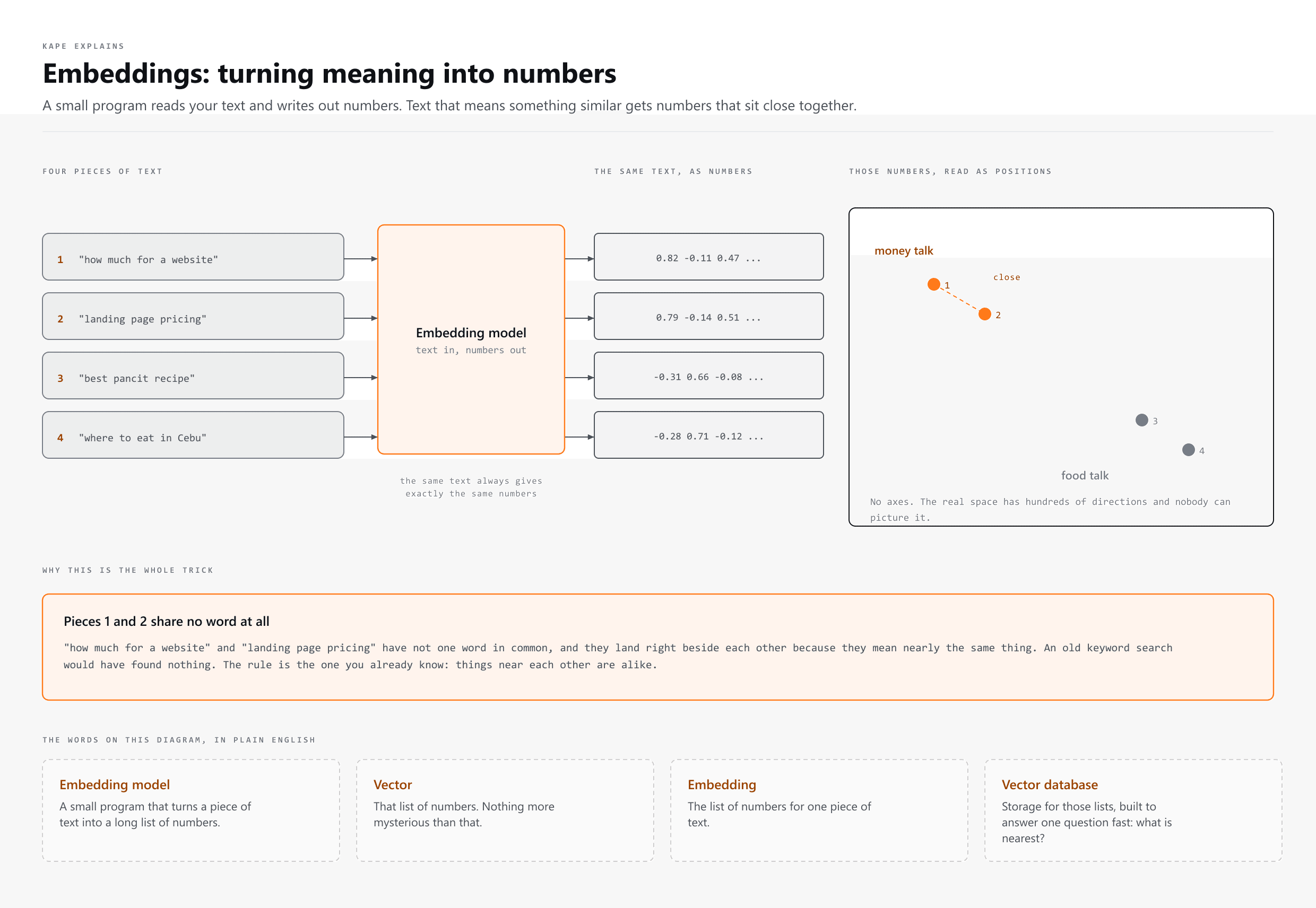
Think of those numbers as coordinates. Two numbers would put something on a map. Three would put it in a room. These lists are hundreds of numbers long, so the "space" is impossible to picture, but the rule is the same one you already understand: things near each other are alike.
A vector database is just the storage for all those number lists, built to answer one question very fast: given this point, what are the nearest ones? "Vector" is only a fancy word for that list of numbers.
Why this beats searching for words
- Your question is turned into numbers by the same model.
- That drops your question at some point in the same space.
- The database finds the nearest pieces of text.
- Those get handed to the AI as the answer material.
So asking "how much for a website" can pull up a file that only ever says "landing page pricing". Not one word matches. They just sit in the same neighbourhood. An old-fashioned keyword search would have found nothing at all.
Why not just paste everything in?
Because there is a limit to how much the AI can read at once, and because quality drops as you fill it up. Pasting a 200-page handbook to ask one question buries the useful paragraph in noise, and you pay for all of it on every message.
RAG sends the three paragraphs that matter instead of the two hundred pages that do not.
Where you already use this
- Project knowledge in Claude: you upload your documents once and every chat in that project can use them.
- Connectors: the AI reaches into your Drive or your notes and pulls only what it needs.
- A support bot that answers from your own help articles instead of making things up.
A freelancer example
You put your rate card, your service agreement and your last ten proposals into a project. Now "write a proposal for a bakery that wants three posts a week" comes back priced from your real rate card, in your real format, with your real terms. You did not paste any of it. It was retrieved.
Where RAG goes wrong
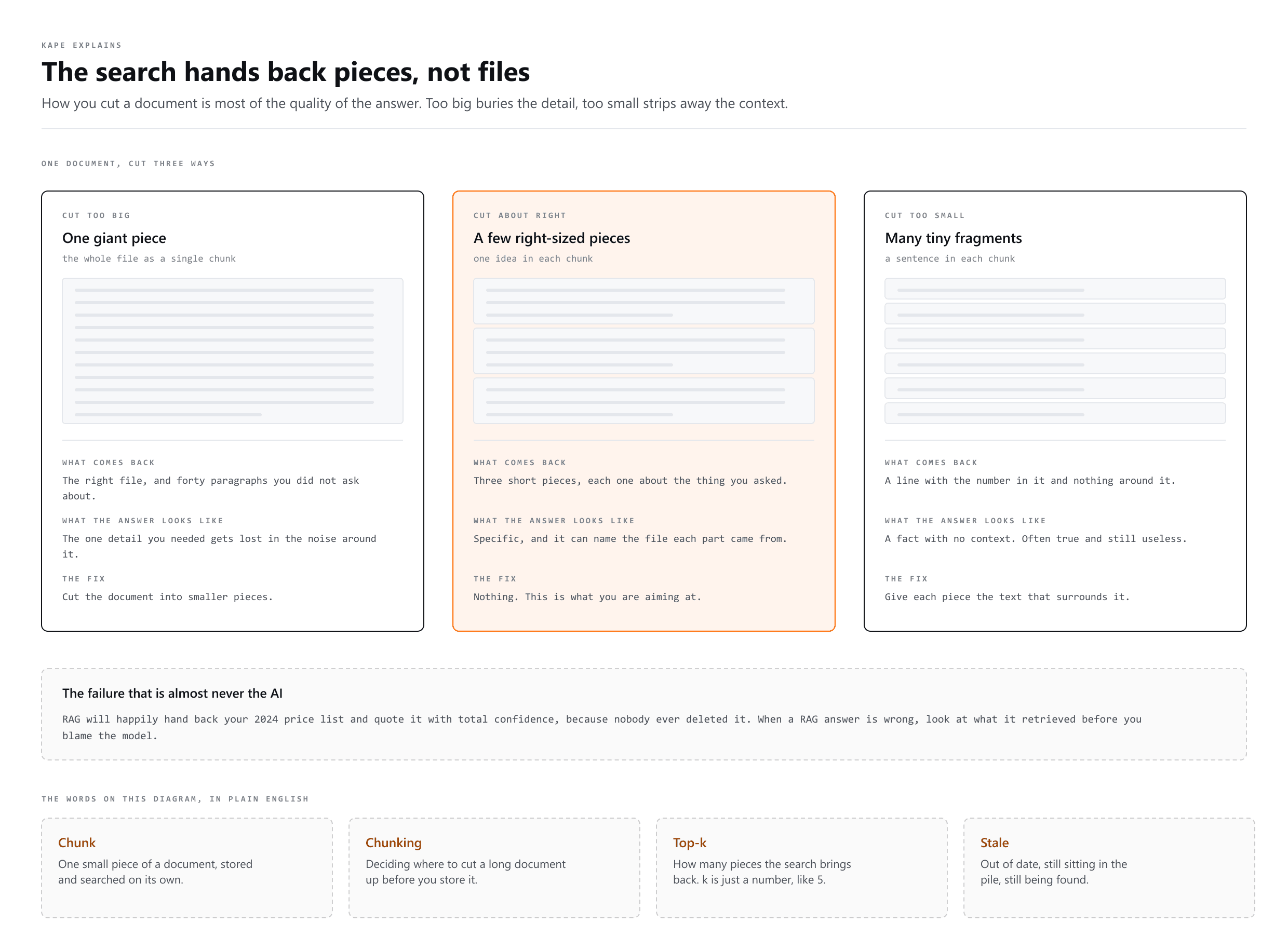
| Problem | What you see | The fix |
|---|---|---|
| Chunks too big | The right file is found but the answer misses the detail | Cut documents into smaller pieces |
| Chunks too small | Answers lose the context around the fact | Give each piece enough surrounding text |
| Bringing back too few | It misses a document that mattered | Raise the number of results |
| Bringing back too many | Noise, slower, worse answers | Lower it again |
| Old documents never removed | Confidently quotes last year's price | Delete or replace what is out of date |
Always ask for the source
A good RAG setup can tell you which file each part of the answer came from. Use that. An answer with a source you can click is checkable. An answer without one is just a claim.
More words
- Prompt Engineering
Writing the instruction so the answer comes back right
- Context Engineering
Choosing what the AI gets to see while it answers
- Loop Engineering
Teaching an AI to check on its own, no prompt needed